What Actually Fails on a Tomball Air Conditioner in August
The heat doesn't kill an air conditioner all at once. It usually gives you warning first, if you know what to listen for.
August 25, 2026 · 4 min read
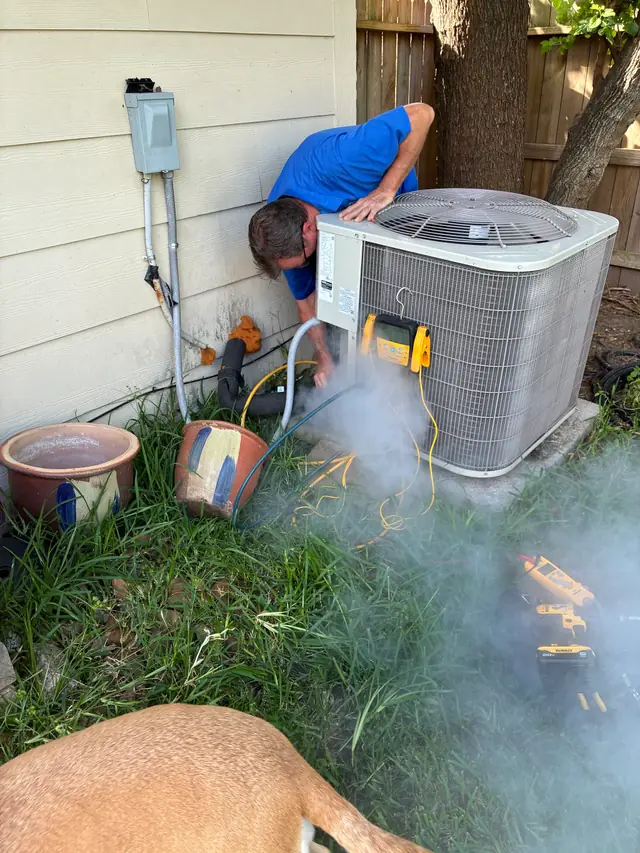
By August, a Tomball air conditioner has usually been running close to nonstop since May. The blackland clay around here holds heat, the humidity keeps the coil working overtime, and most systems in this area log more run hours in a single Texas summer than a unit up north sees in three. Something is going to give eventually. The question is whether you catch it early or find out the hard way, at two in the morning, with the house climbing past 85.
The parts that actually wear out first
Almost nothing fails at random. A handful of components take the brunt of a Gulf Coast summer, and they tend to fail in a predictable order. The run capacitor usually goes first. It's a small cylindrical part that gives the compressor and fan motor the extra push they need to start, and constant cycling in heat wears it down faster than almost anything else in the system. After that it's the contactor, the relay that switches power to the outdoor unit, which pits and burns from thousands of start cycles over a season. Condenser coils are next, caked with cottonwood fluff, pollen and road dust until the system can't reject heat properly no matter how hard the compressor works. And if a system is older or was undercharged at some point in its life, a slow refrigerant leak finally catches up around now, which is exactly the point in the year when the unit has the least margin to spare.
Why this climate asks more of a system than the spec sheet assumes
Most AC equipment is rated and tested for dry heat. Tomball doesn't get dry heat. Humidity forces a system to do two jobs at once, cooling the air and pulling moisture out of it, and that second job (removing latent heat) is the one people forget to account for. An attic air handler sitting above insulation that's already baking in a 140 degree attic is starting every cycle from a disadvantage a system in a drier, cooler climate never faces. None of that is a defect. It's just what this region asks of the equipment, which is exactly why maintenance and early attention to warning signs matter more here than almost anywhere else in the country.
Sounds and smells worth stopping for
- A hard clicking or humming at the outdoor unit with no fan movement, usually a capacitor
- A burning or hot plastic smell from a vent, shut the system off and call, don't wait
- Warm air blowing steadily even with the thermostat set low
- Ice forming on the indoor coil or on the copper line running outside
- Water pooling near the indoor air handler or staining the ceiling below it
- A breaker that trips every time the AC tries to start
Why running a failing system makes it worse
The compressor is the most expensive part in the system by a wide margin, and it's also the part that failing components tend to take down with them. A bad capacitor forces the compressor to hard start over and over. A low refrigerant charge makes it run hot and starved of the oil it needs. A frozen coil can send liquid refrigerant back into a compressor that was only ever built to handle vapor. None of that shows up as a bigger repair bill right away. It shows up two or three weeks later as a system that won't turn on at all. If you've noticed one of the warning signs above, the cheapest version of the fix is almost always the one you call in early, not the one you wait out.
What a same day fix usually looks like
The reason a capacitor or contactor failure doesn't need to turn into a multi-day ordeal is that those parts are common, inexpensive and small enough to keep stocked on every truck. A technician who diagnoses a bad capacitor doesn't need to order one and come back next week. It's in a drawer in the van, and the repair is usually finished within the same visit. The exceptions tend to be a compressor failure or a major coil replacement, where parts availability and the size of the job genuinely require more time. Even then, a technician who's honest about which category your repair falls into up front saves you from sitting around wondering.
What to do about it
Reid's AC & Heating has been fixing these exact failures around Tomball, Spring, The Woodlands, Magnolia, Cypress, Conroe and Pinehurst since 1992, and fast, same day repair is the standard rather than the exception, because the trucks are stocked with the parts that actually fail in this climate. Upfront pricing means no surprise fees once a technician is already at your condenser. If your system is doing any of the above, call (281) 351-9922 before it decides the question for you.
Reid's AC & Heating, (281) 351-9922
Call (281) 351-9922More articles
Repair or Replace: How to Decide Honestly About Your AC or Furnace
The right answer isn't always the expensive one, and it isn't always the cheap one either. It depends on a handful of specifics most homeowners never get told.
Why the Furnace That Runs Ten Days a Year Fails First
A furnace that only runs a handful of days a year doesn't get the luxury of gradual wear. It either works when the freeze hits, or it doesn't.